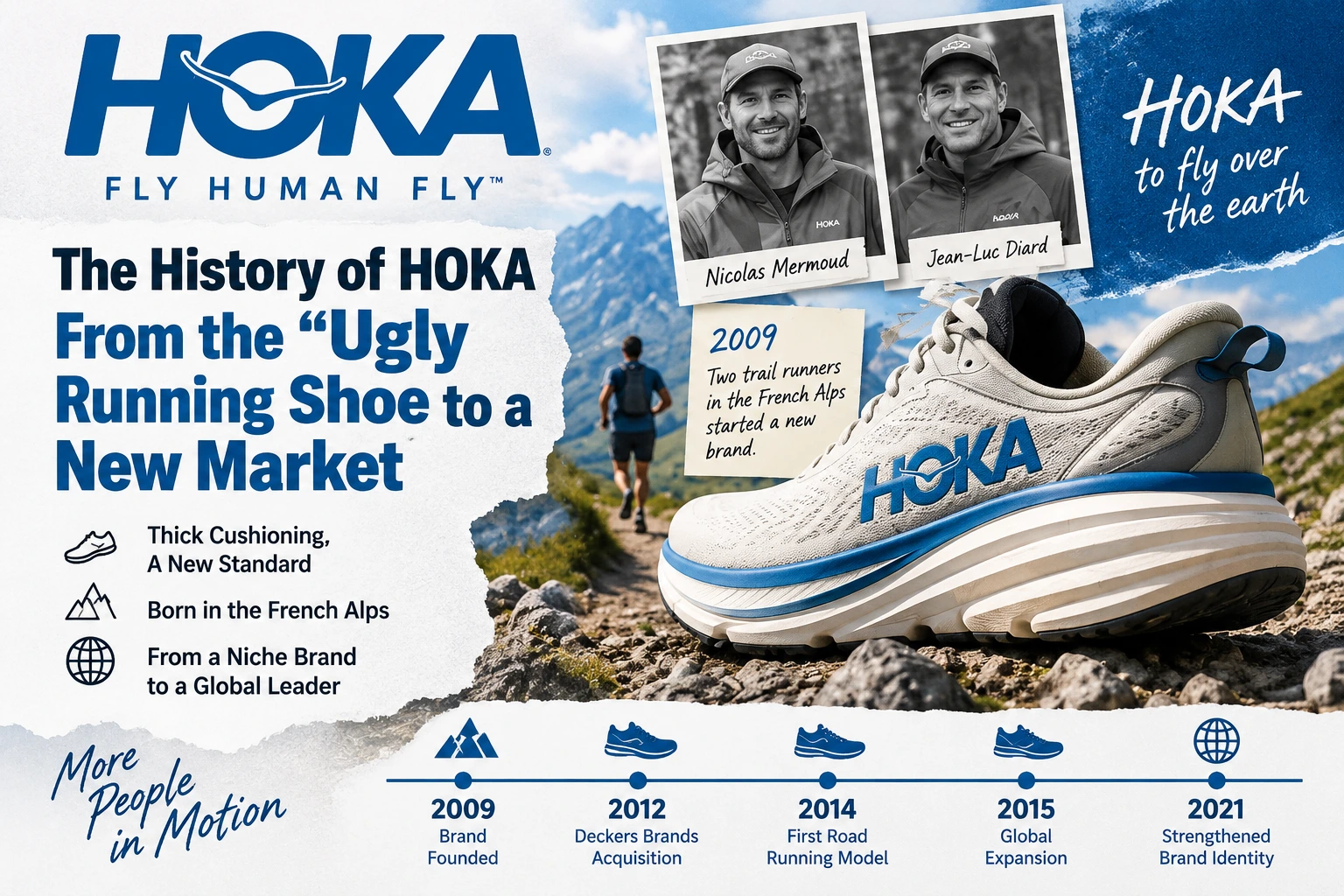
HOKA is a running shoe brand known for its thick cushioning. In 2009, two trail runners created a new type of shoe in the French Alps. Although the design was initially mocked by the running shoe industry, HOKA eventually became one of the leading brands in the maximalist running shoe market.
This article explains how HOKA began, who its founders were, what its name means, and how the brand changed the running shoe industry.
What You Will Learn in This Article
- What kind of brand HOKA is
- HOKA at a glance
- HOKA’s history and major milestones
- Founders Nicolas Mermoud and Jean-Luc Diard
- The origin of the name HOKA
- HOKA’s representative products
- HOKA’s competitive advantages and business structure
- Little-known facts about HOKA
- Frequently asked questions
Key Summary
HOKA is a running shoe company headquartered in Goleta, California, United States. The brand was founded in Annecy, France, in 2009 by Nicolas Mermoud and Jean-Luc Diard under the name Hoka One One. Both founders were trail runners who had previously worked for Salomon, an outdoor and mountain equipment brand.
HOKA was not welcomed by the running shoe industry when it first appeared. At the time, minimalist running shoes with thin and lightweight soles were popular. HOKA took the opposite approach by introducing shoes with unusually thick and oversized midsoles. Because of this distinctive appearance, the shoes were initially described by some people as “ugly.”
However, runners soon recognized the practical benefits of the design. HOKA shoes provided a softer landing and helped runners move more comfortably and quickly, especially on downhill sections. As word spread among ultramarathon and trail running communities, HOKA helped establish maximalist running shoes as an important category in the market.
The name HOKA is known to come from the language of the Māori people of New Zealand. The phrase “Hoka One One” is commonly explained as meaning “to fly over the earth.”
In 2012, HOKA was acquired by Deckers Brands, the American footwear company that also owns UGG and Teva. In 2021, the brand simplified its name from “HOKA ONE ONE” to the shorter and more recognizable name “HOKA.”
What Kind of Brand Is HOKA?
HOKA is a running and walking shoe brand known for its thickly cushioned soles. The brand began with trail running shoes and has since expanded into road running shoes, walking shoes, and lifestyle footwear.
HOKA’s defining characteristic is its product philosophy, which goes against conventional thinking. While the running shoe industry was focused on lightweight and thin shoes, HOKA chose unusually thick and oversized soles to maximize shock absorption and stability.
Another important feature is that HOKA started in a niche market but eventually changed the direction of the mainstream market. The brand began as a shoe for a small group of ultramarathon and trail running enthusiasts, but later helped popularize the concept of maximalist running shoes.
HOKA at a Glance
| Category | Details |
|---|---|
| Brand name | HOKA |
| Former name | Hoka One One |
| Country of origin | France; currently owned by a U.S. company |
| Founded | 2009 |
| Founded in | Annecy, France |
| Founders | Nicolas Mermoud and Jean-Luc Diard |
| Acquired by Deckers Brands | 2012 |
| Headquarters | Goleta, California, United States |
| Industry | Running shoes, walking shoes, and sportswear |
| Representative products | Bondi, Clifton, and Speedgoat |
| Ownership | A brand owned by Deckers Brands |
| Official website | hoka.com |
HOKA’s History and Major Milestones
HOKA did not begin as a product created by a large corporation’s new product division. It started with a shoe developed by two trail runners who repeatedly tested and refined their own ideas. Nicolas Mermoud and Jean-Luc Diard wanted to create a shoe that would allow runners to move faster downhill during long-distance mountain races.
They developed a lightweight shoe with a highly cushioned sole. The result was a shoe that looked completely different from the running shoes available at the time.
Both founders had previously worked for Salomon, an outdoor equipment brand. Jean-Luc Diard had served as the head of the Salomon design center and later became chief executive of the Salomon Group. Using their experience, the two began designing shoes with midsoles that were much thicker than those of conventional running shoes.
The Birth of the “Ugly” Running Shoe
In 2009, the founders created their first prototypes and tested them in real running conditions. The results were impressive. The thick foam sole provided a softer landing than traditional running shoes, while the gradual rocker-shaped design at the front helped create a smooth and natural transition during each step.
That same year, the company officially launched under the name Hoka One One. At the time, minimalism was the dominant trend in the running shoe industry, with brands emphasizing thin and lightweight soles. HOKA’s thick and oversized design looked unfamiliar and unusual. Some people even described the shoes as “ugly.”
Word of Mouth Among Ultramarathon Runners
The response from ultramarathon and trail runners who actually wore the shoes was very different. Word spread that HOKA shoes could reduce the strain placed on the feet and legs during long-distance and downhill sections.
As a result, HOKA quickly built a loyal following among a small but influential group of core runners.
HOKA Becomes Part of Deckers Brands
In 2012, HOKA was acquired by Deckers Brands, the American footwear company that owns UGG and Teva. After the acquisition, HOKA expanded its product range to include road running shoes designed for a broader consumer market.
In 2021, the brand simplified its name from Hoka One One to the shorter and easier-to-remember name HOKA.
Maximalist Running Shoes Enter the Mainstream
HOKA later expanded beyond trail running shoes into everyday road running shoes and walking shoes. The thick-soled design, once considered a niche preference, became a recognized category known as maximalist running shoes.
Major Milestones
| Year | Major event |
|---|---|
| 2009 | Nicolas Mermoud and Jean-Luc Diard founded Hoka One One. |
| 2009 | The company developed new running shoes with thick midsoles. |
| Around 2010 | HOKA gained recognition in the ultrarunning and trail running markets. |
| 2012 | Deckers Brands completed its acquisition of HOKA. |
| 2014 | The Clifton was launched. |
| 2015 | The Speedgoat was launched. |
| 2021 | The brand name was simplified from HOKA ONE ONE to HOKA. |
| Late 2010s | HOKA expanded into road running and walking shoes. |
HOKA Founders: Nicolas Mermoud and Jean-Luc Diard
Nicolas Mermoud and Jean-Luc Diard were trail runners who had previously worked together at Salomon, an outdoor and mountain equipment brand. Diard led the Salomon design center and later served as chief executive of the Salomon Group.
The two founders did not start HOKA as a conventional corporate business project. They began with a problem they had personally experienced while running long-distance mountain races: they wanted to create shoes that would allow runners to move faster and more comfortably downhill.
The Origin of the Name HOKA
The name HOKA is known to come from the language of the Māori people of New Zealand. The phrase “Hoka One One” is commonly explained as meaning “to fly over the earth.” The pronunciation is generally understood to be close to “Ho-ka Oh-nay Oh-nay.”
The meaning of “to fly” is also connected to the experience HOKA aims to provide. The brand name reflects the idea that thick cushioning can help runners feel light and smooth, almost as if they were gliding or flying over the ground.
In December 2021, the company announced that it would simplify the brand name from “HOKA ONE ONE” to the shorter name “HOKA.”
HOKA’s Representative Products
| Product | Introduced | Main feature |
|---|---|---|
| Mafate | 2009–2010 | One of HOKA’s early representative trail running shoes |
| Bondi | 2010s | A representative model in HOKA’s road running lineup |
| Clifton | 2014 | A popular model known for lightweight and smooth cushioning |
| Speedgoat | 2015 | A representative model in HOKA’s trail running lineup |
The Clifton played an important role in helping HOKA become widely known among everyday runners, beyond the original trail running community.
HOKA’s Competitive Advantages and Business Structure
HOKA’s competitive advantages can be summarized in three areas.
First, HOKA changed the direction of the market through its product philosophy. Instead of following the existing trend, the brand took the opposite approach. This design eventually contributed to the growth of maximalist running shoes as a major category.
Second, HOKA built trust within the core running community. The brand’s reputation grew through the real-world experiences of ultramarathon and trail runners rather than through mass marketing alone.
Third, HOKA benefited from the distribution network and financial resources of Deckers Brands. After the acquisition, HOKA gained access to larger distribution channels and greater capital, which supported its entry into the mainstream market.
HOKA also faces challenges. As other brands quickly introduced similar maximalist designs, HOKA’s distinctiveness became less obvious than it was in the early years. Some consumers also remain divided over the weight and stability associated with thick soles.
Major Competitors
| Brand | Country of origin | Main area of competition |
|---|---|---|
| Nike | United States | Overall running shoe market |
| ASICS | Japan | Overall running shoe market |
| On | Switzerland | Premium running shoe market |
| Salomon | France | Trail running shoe market |
| New Balance | United States | Overall running shoe market |
The relationship with Salomon is particularly interesting. Both HOKA founders previously worked for Salomon, so the two brands share a connection through their founders while now competing in the trail running shoe market.
Little-Known Facts About HOKA
HOKA was mocked by parts of the industry when it first appeared. At a time when minimalist running shoes were popular, HOKA introduced unusually thick soles and was described by some people as “ugly.”
The founders came from an outdoor equipment company rather than a traditional footwear company. Nicolas Mermoud and Jean-Luc Diard started HOKA after working together at Salomon.
The name HOKA came from a language that may seem unrelated to a footwear company. Although the brand began in France, its name was taken from the language of the Māori people of New Zealand.
The maximalist running shoe movement represented by HOKA later became a major category across the industry. Designs that were once considered unusual are now produced by many competing brands.
Frequently Asked Questions
What country is HOKA from?
HOKA was founded in France, but it was acquired by the American company Deckers Brands in 2012. It is now operated as a brand headquartered in Goleta, California.
When was HOKA founded?
HOKA was founded in 2009 in Annecy, France.
What does the name HOKA mean?
The name HOKA is commonly explained as meaning “to fly over the earth” in the language of the Māori people of New Zealand. The original name “Hoka One One” was shortened to “HOKA” in 2021.
Who founded HOKA?
HOKA was founded by Nicolas Mermoud and Jean-Luc Diard. Both were trail runners who had previously worked together at Salomon.
Why was HOKA initially unpopular?
At the time, thin and lightweight minimalist running shoes were the dominant trend. HOKA’s thick soles were the opposite of that trend, so the shoes were initially described by some people as “ugly.”
Who owns HOKA?
HOKA is owned by Deckers Brands, an American footwear company that acquired the brand in 2012. Deckers Brands also owns UGG and Teva.
What is the relationship between HOKA and Salomon?
There is no direct ownership relationship between the two brands. However, both HOKA founders previously worked for Salomon. Today, HOKA and Salomon compete in the trail running shoe market.
HOKA in One Sentence
HOKA was created by two Salomon-trained trail runners to solve problems they experienced on mountain trails. Although its thick-soled shoes were initially mocked as “ugly,” the brand helped establish maximalist running shoes as a major category.
Related Brand Articles
- ASICS — Another major competitor in the running shoe market
- Nike — Another brand that began with sports culture
- Patagonia — Another outdoor brand that began with a founder’s personal need
- Adidas — Another brand whose name has a regional-language origin
Sources
- HOKA official corporate information, “About Us”
- Deckers Outdoor Corporation official SEC filings, 10-K, March 2013
- Deckers Brands official press release, “HOKA ONE ONE Brings Revolutionary Brand Experience Beyond Running”
- Business of Fashion, “How the Company Behind Uggs, Teva and Hoka Makes Ugly Brands Cool”
- Wikipedia, “Hoka” — used for cross-checking
Content updated: September 15, 2026
Company information and product lineups may change. Please check the official HOKA website for the latest information.